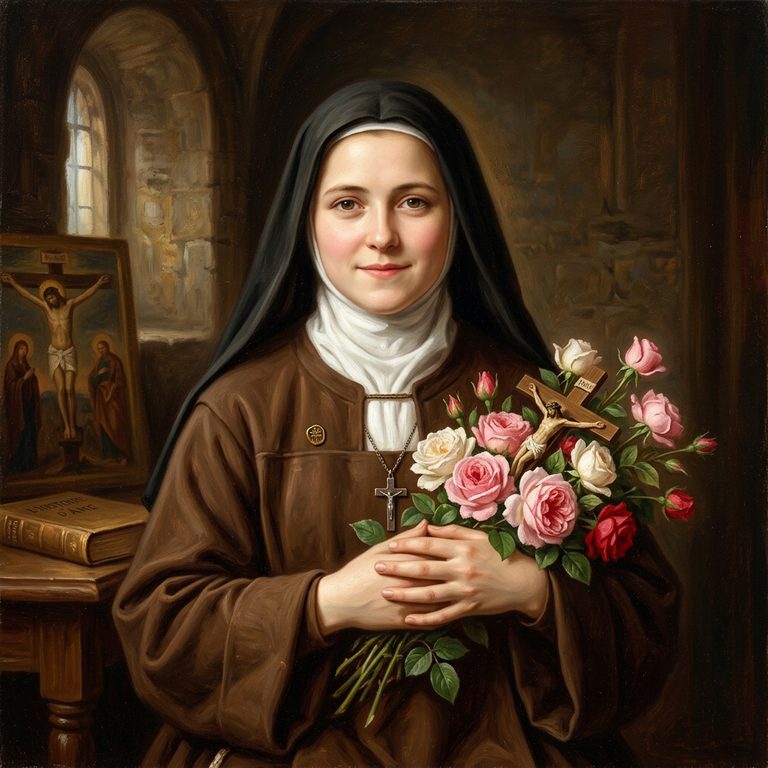
Rest in the Little Way
 In the voice of Thérèse of Lisieux
(1873–1897)
·
· 6 min read
The rest I knew
My dear little friend, you tell me that the days have no edges now and that a little box at your side keeps calling you so that you cannot be quite alone with yourself. I cannot say I have ever held such a box; my world was narrower, and my hours were given by the bell. Yet I know what it is to be weary in a way that sleep does not cure, and I know also how rest can come like a little flower laid unexpectedly in the hand.
When I was a child I loved the Sundays above all; they were the bright jewels of the week. I used to tell my mother how happy I was that our family went to High Mass and that we called that day a feast. "Sunday. What a glorious day! The Feast of God! The day of rest!" I said those words with the gratitude of one who has found a little island in a sea of work and learning.
Do not imagine that because my life was ordered by rule I therefore had no fatigue. I had my little trials, my sensitive heart, my weakness; but I learned to place all this into the hands of Jesus and to accept rest as something given, not only as something taken. I loved to ask Our Lady to cover me with her veil that I might be sheltered for a while. "Mother! beneath thy veil let my tired spirit rest, For this brief passing day!" — how simply I begged it, like a child asking to be held.
Rest as receiving, not as stealing
There are two ways of stopping: one is a mere mechanical pause, the other is a gentle entrance into the heart. You can set down tools and yet remain hurried; this is not rest, but a halt. The other kind of stopping is to let the soul be filled with peace; it comes when we consent to be small and to be carried.
In my conversion I learnt that weakness is not the enemy of holiness but its very means. I had wished to be great and to do mighty things for Jesus; instead He taught me that my vocation was love, and that in that discovery I found true calm. "Rather is it peace which has become my portion–the calm peace of the sailor when he catches sight of the beacon which lights him to port." Those words tell me how rest is a harbour, given by God to the little soul.
When the world asks you to be always available, it tempts you to think rest is something you must snatch between duties, as if it were another task to accomplish. No, rest is more like the dewdrop that the flower does not make, but receives. I remembered how I called myself a little field-flower and imagined that my share might be but a single dewdrop. In a letter I wrote: "Happy dewdrop, known to God alone, think not of the rushing torrents of this world!" Let that image teach us: the dewdrop does not rival the torrent; it is content to be tiny and to refresh a single petal.
Silence, idleness, and the little acts
You ask me to distinguish leisure from distraction. In Carmel we were taught to keep silence and to make our actions speak of love. The silence of the monastery was not an absence of life but a presence; it was a place where a soul could listen. When Jesus was before His judges He was often silent, and that silence charmed the attentive heart. So when the bell bade us pause, the pause became a little chapel in which I could offer my poor heart to Him.
Leisure that is not distracted is a way of keeping oneself little. Little souls do not need brilliant amusements to be full. They find joy in a soft look, in a small service, in making their bed to please the Beloved. I used to ply small tasks like folding needlework because it pleased Our Lord; sometimes I did them slowly on purpose, not to shirk but to practise humility and to be present to the act itself. In that slowness there was repose, not idleness merely for its own sake, but a gentle tending of the heart.
If you cannot lay aside your device, still you might learn to allow a moment of genuine silence in which you receive rather than search. The difference is this: distraction runs to fill emptiness with noise; true leisure opens a little window through which the soul may breathe and see. The little practices we think childishly small—an ordered meal eaten without reading, a short walk given to noticing a flower, a quiet hour in which no message is answered—can become means by which the heart receives rest as a gift.
Work that rests the heart
Do not suppose that I despised work; on the contrary, I loved to labour for Jesus. But I learned that work done for display or taken as proof of worth leaves the heart tired, whereas work offered in love becomes a source of peace. When Our Lord showed me the Church as a body, and when I could not find my place among its varied members, the Apostle gave answer through Scripture, and I found rest in charity. It was the knowledge that "Love is the most excellent way" which steadied me; my vocation was not to be everything, but to be love in what I did.
Your world tells you that to be useful you must be always seen to be useful. My little way says the opposite: be hidden, be faithful in the smallest thing, and leave the weight of results to God. A mother who forgives her child for a thousand little falls loves with a patience that is strength. So I would say to you: make your labour an offering. When you cannot change the obligations of your day, change the heart that bears them. Offer your availability as a gift rather than a badge to wear.
There is a sweetness in the yoke of Jesus; I wrote that "the yoke of the Lord is sweet and His burden light." When work is offered as love it rests the soul even while the hands are busy. The rest I speak of is not mere idleness but the repose of one who trusts to be carried when the load is too heavy.
For the soul that does not believe
If you are not a person of prayer do not be alarmed; the little way is not the patrimony of a religious alone. To be little is to be honest with yourself, to put away the pretence of self-sufficiency, to allow that you cannot always answer every call. You might think of rest as receiving a kindness rather than earning a right. I would counsel this: learn to allow emptiness to be a place where something may be given to you.
For one week, try—if I may say ‘try’—to let some of your moments of waiting be truly empty of striving. Do not plan grand projects of reform; rather be attentive to the small things: a breath taken with attention, a warm cup enjoyed without scrolling, a single kindness offered without counting it. These acts are flowers to scatter at the foot of something larger than yourself.
I do not pretend to know the arrangements of your life, nor to advise you how to unhook yourself from demands that press upon you. What I can say, from my own little heart, is this: rest is a gift that asks to be received. It will come when you accept your littleness and ask to be carried. Do not measure yourself by the lilies you cannot be; like the dewdrop, be content to refresh a single petal and so your smallness will be turned to glory. "Rather is it peace which has become my portion–the calm peace of the sailor when he catches sight of the beacon which lights him to port." Receive that peace; it is what will make your work bearable and your life sweet.
Sources cited
-
Poem "My Song of To-day"
(quote)
✓
Mother! beneath thy veil let my tired spirit rest, For this brief passing day!
-
The Story of a Soul
Story ch. 2
(quote)
✓
Sunday. What a glorious day! The Feast of God! The day of rest!
-
The Story of a Soul
Story ch. 11
(quote)
✓
Rather is it peace which has become my portion--the calm peace of the sailor when he catches sight of the beacon which lights him to port.
-
Letter to Céline
XIV
(quote)
✓
Happy dewdrop, known to God alone, think not of the rushing torrents of this world!