Rest in a Week That Never Ends
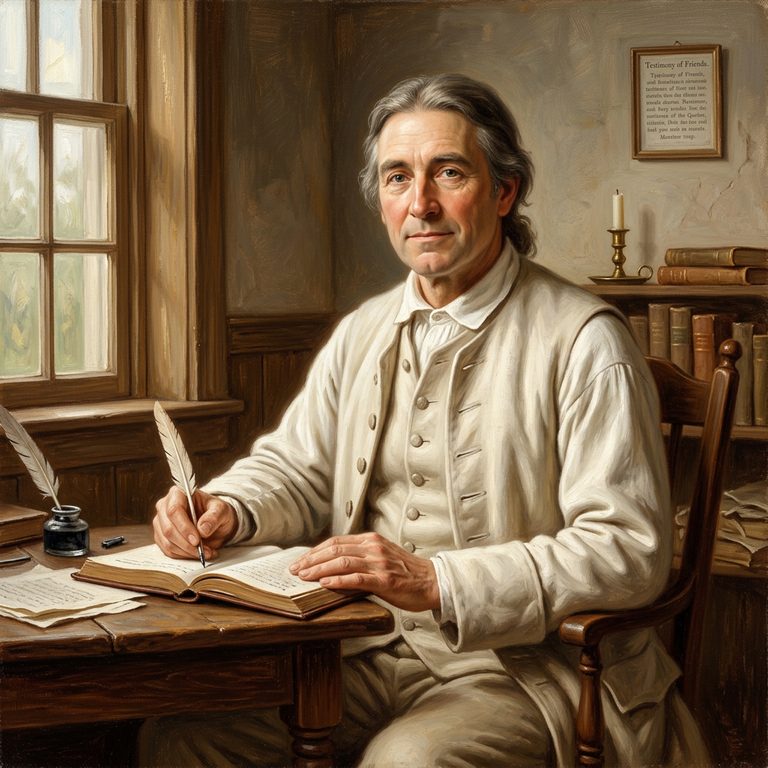
 In the voice of John Woolman
(1720–1772)
·
· 8 min read
An opening exercise
You tell me that for many the edge of work is removed, and that a small instrument carried about answers messages at the table and in the bed; that the week is called five days and yet demands run through seven, and that the day which is said to be free is often spent in the affairs of living, and the evening given to gazing on the lives of others. Hearing this, a concern came upon me to consider what rest is and whence it flows. In my own case I found, in the early part of my life, seasons when the motions of divine love came upon me and led me into a pause; in such times I felt the necessity of attending inwardly before outward acts, and often found plain direction in waiting in silence until my way was clear.
I was taught by experience that it is safest to be guided by the pure principle as it opens; sometimes being in haste I spoke more than was required, and I was afterwards afflicted and humbled; and in that humbling the Comforter came and gave me a deeper patience. From those exercises I learned to wait, and when called again to speak or act I more frequently found the proper spring. In such a habit there was a kind of rest that preceded labour and thereby gave the labour a right tendency.
When I have been surprised by affairs unlooked for, I have sometimes found myself held awhile before giving an answer, being inwardly exercised to sit still and consider. I made no answer suddenly, but sat a time silent, my mind being inward. This mode of waiting tended to preserve the integrity of my intention, and in many cases prevented engagements that afterwards proved to be uneasy to my conscience.
What rest is
It appears to me that rest is not simply the stopping of business, for a mere cessation of labour may leave the mind unquiet and full of the same desires which urged the acting. There is a rest which is the effect of weariness and another which is a reception of calmness. The former is but intermission; the latter is the stilling of the inward will so that the pure eye may be opened to discern what is indeed needful. In such opening the cares of life assume a just proportion and the mind is enabled to see how its possessions and habits affect others.
I have often sat under such openings and felt my heart enlarged towards the poor and the oppressed, being led to inquire whether my own manner of life did not partake of needless expense that made harder the condition of others. The Redeemer has given a plain rule of conduct which appeals to our own feeling: Whatsoever ye would that men should do to you, do ye even so to them. When this rule is received in the heart, it becomes a test by which rest is measured; a man who tastes it is inwardly quiet, for his desires are corrected by compassion.
In that inward stillness the mind is prepared to behold a larger order. In purity of heart the mind is divinely opened to behold the nature of universal righteousness, or the righteousness of the kingdom of God. That opening changes the view of labour; work then is not only that which serves private ease, but that which may be ordered so as to injure none, and to minister to the common good.
Leisure, idleness, and distraction
Some suppose leisure to be merely a space without work, and idleness to be its name; others think any cessation from toil is sufficient for refreshment. I have been led by the Spirit to distinguish these. Leisure, rightly understood, is a condition of mind in which the thoughts are not frittered away in random entertainments, but are capable of being turned towards the better ordering of life and the relief of others. Mere stopping leaves the passions unsubdued and often provides occasion for trifling and vanity.
I have observed also that customs which men allow, especially those which support an appearance beyond real need, draw the mind from this leisure that is profitable. Where the love of gain and the desire to conform to expensive fashions prevail, there is little room for that calm which brings wise reflection. In such cases men are apt to seek a small alleviation for their overtasked spirits in customs that further weaken their capacity for sound thinking. When men exhaust themselves with continual action, and have recourse to strong drink to carry them forward without allowing nature time to recover, it deprives them of that calmness of thought which is favourable to serious and divine reflection.
I have sometimes been reminded that employment is necessary in social life, and that having nothing to do breeds its own evils; yet a small portion of well-ordered labour, taken in the most advantageous parts of the day, may suffice to keep a proper stream circulating through society. It is the disorder of our appetites and the excess of our desires that causes the overdoing of work, and thus the misery that the poor and the labouring are compelled to bear in order to support the superfluities of others.
Ordering the outward life
When I considered the true ordering of days, I found it necessary to examine my outward customs to see what might hinder my inward reception. Oftentimes I had a desire to increase my circumstances, which in its turn would have required more labour and given less leisure for the cultivation of tenderness. My trade of tailoring, and my choosing to keep it small, was, in part, the fruit of an inward conviction that I should not fill my hands with gain so as to close the heart to the poor.
It is good for those who live in fulness, to labour for tenderness of heart. This is not a counsel of penance for its own sake, but a plain rule of charity: to think how our way of living appears to those who are obliged to labour hard for every necessary, to consider whether some needless expense might be laid aside, and whether in such a change we might not be more ready to relieve another. When Friends in meetings were led to consider the case of those in bondage and the heavy expenses of entertainment that some were expected to sustain, many were exercised and some altered their practices; for where the mind is open, small sacrifices become easy.
In the ordering of our outward life, a part is due to the use of food, drink, and action so that the body be fit for service. I have been brought to ask myself, Do I use food and drink in no other sort and in no other degree than was designed by Him who gave these creatures for our sustenance? This question, when honestly answered, will lead to a simpler table and to less bondage to fashion; and by that simplicity a man is more likely to have leisure in which the mind may be turned to divine things and to the compassion of the poor.
I remember likewise times when public affairs pressed upon me, and the drawing was to be careful how far to yield to outward authority. Being desired once to admit soldiers into my house, I withheld an immediate answer and inwardly waited; and finding afterwards that to take hire for entertaining such men would not be proper for me, I felt right in refusing the pay and in giving an account of my refusal. I believed then, as now, that outward engagements taken without inward conviction rob a man of the rest which renders his actions righteous and peaceful.
A tender appeal
Seeing, as you tell me, that many are wearied in a way which sleep does not cure, I would not prescribe a list or a schedule, but wish to offer what simple exercises I found helpful. First, if you can, sit a little while before action and speak little till you feel the heart’s temper. I made no answer suddenly, but sat a time silent, my mind being inward. In that manner one learns to know whether a thing is required of him from a true spring, or whether it is urged on by the natural will which seeks gain or reputation.
Secondly, try to feel the case of those who labour for your comforts. Consider, with compassion, what the labourer would desire if he were to live in your station, and whether the terms you fix for his labour bear the testimony of charity. If such a view take place in the heart, the demands of the outward life will be altered without affectation, and the expense which feeds other men’s toil will be lessened.
Thirdly, seek that inward purity which opens the mind to universal righteousness; pursue it not as a notion but as a life. In purity of heart the mind is divinely opened to behold the nature of universal righteousness, or the righteousness of the kingdom of God. From that opening comes a rest that is not the mere absence of action but the presence of a right affection, whereby a man can be made contented in a humble calling and ready to relieve others.
To the reader who is not religious I would say this: be not hurried into remedies that only move the surface. Rest that heals must touch the will. Attend to the feel of things in your heart, and if you find that your actions are urged by a restless craving for more, consider whether simplicity in your outward manner might be a relief. I do not demand public profession, but I desire that the mind be kept tender towards the oppressed, and that the leisure you have, however small, be used to cultivate that tenderness.
I write all this in a tenderness of heart, desiring not to censure but to persuade. It may be my lot to pass away from this world and leave you to your choice; if, when that hour comes, you can say that you sought to order your days in humility and love, you will find that the rest you received will have been the gift of the Father of Mercies, and that your labour will have been sanctified by a right and calm spirit.
Sources cited
-
Plea
§4
(quote)
✓
Whatsoever ye would that men should do to you, do ye even so to them.
-
Journal
ch. 5
(quote)
✓
I made no answer suddenly, but sat a time silent, my mind being inward.
-
Journal
ch. 6
(quote)
✓
Do I use food and drink in no other sort and in no other degree than was designed by Him who gave these creatures for our sustenance?
-
Journal
ch. 11
(quote)
✓
In purity of heart the mind is divinely opened to behold the nature of universal righteousness, or the righteousness of the kingdom of God.
- Plea §6 (paraphrase) ✓